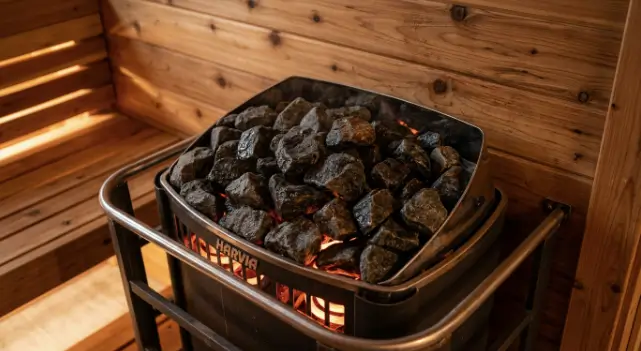
An electric sauna heater’s real cost depends heavily on the situation it goes into: a small basement corner unit with nearby electrical access might run $1,200 all-in, while a detached garage conversion needing a new circuit run can reach $2,500, and a from-scratch backyard cabin build often lands between $2,000 and $4,000 once the heater, wiring, and any contactor equipment are included. The unit price alone, typically $500 to $2,000 depending on kilowatt rating, is rarely the number that determines the final budget. What surrounds it, mainly electrical access, usually is.
Scenario: A Small Basement Corner Sauna
Basements often already have decent electrical panel access nearby, which keeps this scenario relatively affordable. A 4.5 to 6 kilowatt heater suited to a two-person basement cabin typically costs $500 to $900 for the unit itself. If the panel has spare capacity and the distance is short, a dedicated 240-volt circuit often runs $300 to $600. Add $150 to $300 for rocks and basic accessories, and a straightforward basement install commonly totals $950 to $1,800 before any labor for the cabin structure itself, assuming the wood shell is already built or purchased separately.
Scenario: A Detached Garage Conversion
Garage conversions add distance and sometimes panel capacity issues to the mix, since a detached garage’s subpanel may already be near its load limit. The heater cost itself does not change based on location, staying in the same $500 to $2,000 range depending on size, but the electrical run often costs more here, commonly $600 to $1,500, because the run is longer or a subpanel upgrade is needed to support the new 240-volt circuit alongside existing garage door openers, outlets, and lighting. Total costs for a garage conversion, heater plus electrical, typically land between $1,300 and $3,000 before any structural work on the cabin walls.
Scenario: A Backyard Cabin Build From Scratch
This is the most expensive electrical scenario because the site usually starts with no existing power at all. Trenching a new circuit run from the house or a subpanel to a backyard structure often costs $800 to $2,000 depending on distance and whether the run crosses concrete, landscaping, or requires boring under a walkway. A larger heater, often 6 to 9 kilowatts for a full-size backyard cabin, adds $900 to $2,000 for the unit. All told, the electrical and heater combination for a from-scratch backyard build commonly reaches $2,000 to $4,000, separate from the cost of the wood structure itself, which is why this scenario benefits most from getting an electrician’s quote before committing to a specific spot in the yard.
Scenario: An Apartment or Condo With Limited Electrical Access
This scenario has a hard ceiling that the others do not. Most condo and apartment electrical systems, and many HOA agreements, do not allow adding a new dedicated 240-volt circuit, which rules out heaters above roughly 2 kilowatts. A smaller heater running on a standard 120-volt outlet typically costs $250 to $500 for the unit, with little or no additional electrical cost since it plugs into existing household wiring. The tradeoff is cabin size: a 120-volt heater realistically only heats a very small one-person space effectively, so this scenario works for buyers with modest space and modest expectations rather than anyone planning a multi-person cabin.
Scenario: Replacing an Old Heater in an Existing Sauna
Replacing a heater in a cabin that already has wiring run and a working circuit is by far the cheapest scenario, since the expensive part, the electrical infrastructure, is already in place. A comparable replacement heater typically costs $500 to $1,200 depending on size, plus $100 to $600 in labor if an electrician is hired to disconnect the old unit and connect the new one, which is often a good idea even for a straightforward swap since heater wiring should be handled by someone qualified regardless of how many times it has been done before. Buyers comparing replacement models by kilowatt rating and features, including options across the SweatDecks catalog, generally find this the fastest scenario to budget accurately, since there is no guesswork about electrical costs that have not been priced yet.
What Does It Cost to Actually Run the Heater Afterward?
Installation is a one-time cost, but the electric bill keeps going after the last invoice is paid, and it is worth budgeting for. A 6 kilowatt heater running for a typical 45-minute preheat and session, roughly 1.5 hours of draw counting cycling on and off rather than running flat out the whole time, uses somewhere around 3 to 4 kilowatt-hours per session. At a national average residential rate, that works out to well under a dollar per session in most areas, so three sessions a week adds up to a modest amount on a monthly bill, usually in the range of a few dollars to around ten depending on local electricity rates and how long each session runs. Larger heaters at 8 to 9 kilowatts cost proportionally more per session but still remain a minor line item compared to the upfront electrical and unit costs in any of the scenarios above. Buyers worried about ongoing cost are usually better served focusing on getting the kilowatt sizing right in the first place, since an undersized heater running constantly to chase a temperature it cannot reach ends up costing more in electricity over time than a correctly sized unit that reaches target temperature and then cycles normally.
What Do These Scenarios Have in Common?
Across all five situations, the heater unit itself is rarely the line item that swings a budget. Electrical access, specifically how far the sauna sits from existing panel capacity and whether a new circuit or subpanel is needed, is what separates a $1,200 project from a $4,000 one at the same heater kilowatt rating. Getting an electrician’s quote for the specific site before finalizing a heater choice, rather than after, is the single most reliable way to avoid a budget that looks reasonable on paper and turns out to be significantly higher once the actual wiring run gets priced.
Frequently Asked Questions
What does a basic electric sauna heater cost by itself? A residential 4.5 to 6 kilowatt heater typically costs $500 to $900. Larger 8 to 9 kilowatt heaters run $1,200 to $2,000, before rocks or installation.
How much does it cost to add a 240-volt circuit for a sauna heater? A straightforward run near the panel often costs $300 to $600. A longer run or subpanel can push it to $1,000 to $1,800 or more.
Can an apartment or condo have an electric sauna heater? Only with heaters under about 2 kilowatts on a standard 120-volt outlet, since most condo systems and HOA rules do not allow a new 240-volt circuit.
Is it cheaper to replace just the heater instead of the whole sauna? Yes, usually significantly, often $600 to $1,800 total versus several thousand for a full new kit with fresh electrical work.
References
- Cardiovascular and Other Health Benefits of Sauna Bathing: A Review of the Evidence, Mayo Clinic Proceedings, 2018
- Clinical Effects of Regular Dry Sauna Bathing: A Systematic Review, Evidence-Based Complementary and Alternative Medicine, 2018
- Benefits and risks of sauna bathing, The American Journal of Medicine, 2001
By Dale Brennan
